
Meagan Elliott, Kelsey Russell, Mark O’Donoghue, Fiona Schmiegelow
Tr’ondëk Hwëch’in, Nacho-Nyak Dun, Selkirk, and Little Salmon Carmacks
Background
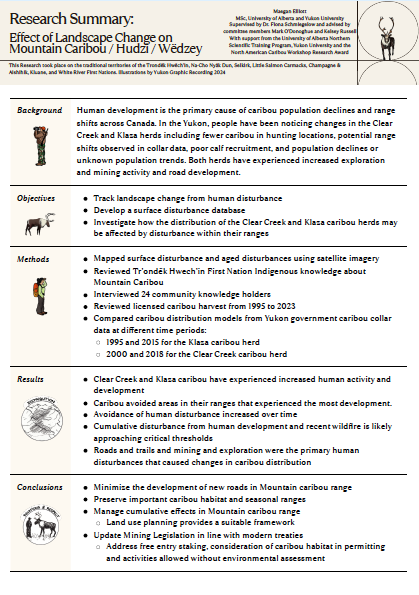
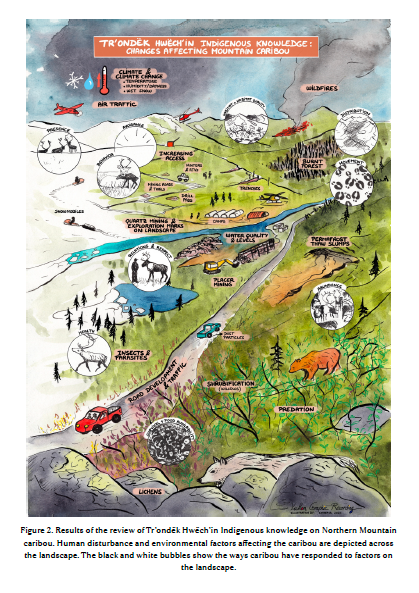
This research documents and quantifies trends in surface disturbance and its effect on the distribution of two Northern Mountain caribou (Rangifer tarandus caribou) herds, the Clear Creek and Klaza caribou herds using satellite imagery, field-based ground-truthing, and verification from community knowledge holders. I drew on multiple information sources and ways of knowing to better understand changes people observed in each caribou herd. These qualitative and quantitative analyses demonstrated alignment, indicating human disturbance influenced caribou distribution: Caribou avoided areas in their range with the most surface disturbance and access, and the effect of disturbance was unique to each season and increased over time. Roads, trails and mining and exploration features were the greatest sources of landscape change that contributed to changes in caribou distribution. Licensed harvest decreased over time in concert with caribou distribution changes identified by Indigenous and community knowledge holders and in the seasonal models. These multiple lines of evidence demonstrate human development has influenced the Clear Creek and Klaza caribou herds, and indicate Northern Mountain caribou require improved management of industrial activity, access and cumulative effects within herd ranges.

Methods
Methods
 Northern Systems Conservation Co-Lab